
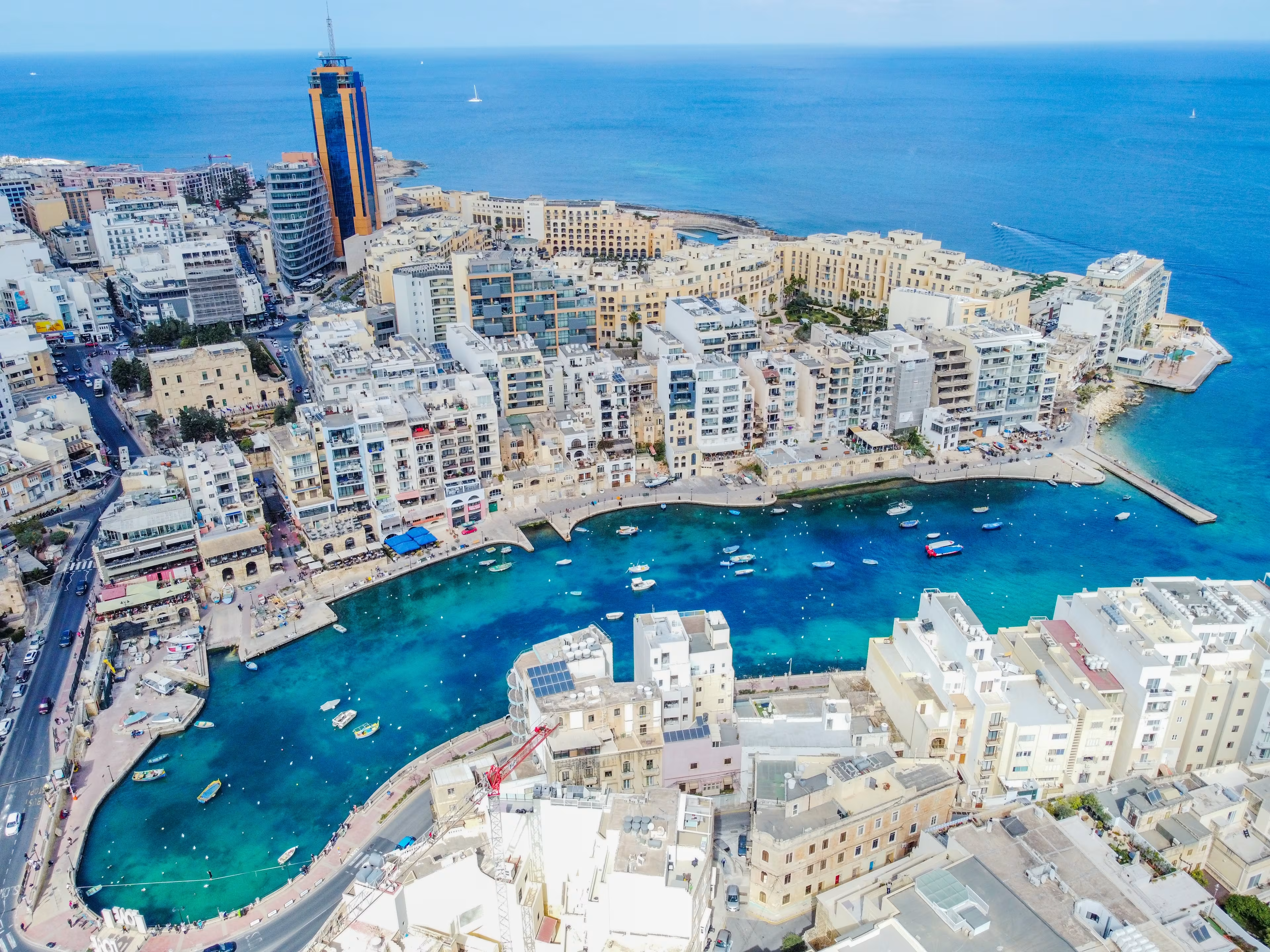
Securing Optionality: Why Middle Eastern HNWIs Are Choosing Malta Permanent Residence
Faced with escalating regional pressures, wealthy families across the Gulf are investing in a parallel European anchor. Discover why Malta has become the definitive answer for long-term security.
Why High-Net-Worth Individuals Are Leaving the Middle East and Why Malta Is Becoming Their Answer
The Middle East has long been home to some of the world’s most concentrated private wealth. Successful business families, investors, and entrepreneurs have built their lives across cities like Dubai, Riyadh, and Amman - drawn by economic opportunity, low taxation, and a dynamic business environment that positioned the region as a genuine global hub.
That picture has not disappeared. But something has shifted.
A growing number of high-net-worth individuals (HNWIs) based in the UAE, Saudi Arabia, and Jordan have been quietly making a different kind of investment — not in property or equities, but in optionality. They are securing a second residency in a stable, well-governed jurisdiction outside the region. And increasingly, that jurisdiction is Malta.
This is not panic. It is planning. And understanding why requires an honest look at what the current regional environment means for families who have spent decades building wealth in the Middle East.
A Region Under Sustained Pressure
The Middle East has always carried geopolitical complexity. What has changed in recent days is the scale, proximity, and unpredictability of the disruptions affecting the region’s most prosperous countries.
The ongoing military conflict involving Iran, Israel, and the United States has fundamentally altered the security architecture of the region. It is no longer a distant concern. Strikes have targeted critical infrastructure across the Gulf. Major airports have suspended operations. Key oil facilities have been hit. Shipping through the Strait of Hormuz — one of the world’s most critical trade chokepoints — has been disrupted, sending energy prices sharply higher and rattling global markets. Airspace across the region has been repeatedly closed, disrupting travel and international connectivity that businesses and families depend on.
For countries like the UAE and Saudi Arabia, which have invested heavily in positioning themselves as global hubs for finance, tourism, logistics, and technology, this kind of instability does not simply affect headlines. It affects the underlying business case for why global capital and global talent chose to base themselves there in the first place.
Jordan occupies a different but equally exposed position. Sharing borders with multiple conflict zones and navigating intense domestic pressures, the kingdom has found itself caught between regional forces it cannot fully control. Its economy heavily reliant on tourism, trade, and foreign investment has absorbed the consequences of sustained regional instability for several years running, and the pressures show no sign of resolving in the near term.
What HNWIs Are Actually Responding To
Wealthy families do not leave regions impulsively. The decision to pursue a second residency is calculated, deliberate, and usually the result of a risk assessment that has been building over time.
What is driving that assessment across the UAE, Saudi Arabia, and Jordan right now is a combination of factors that individually might be manageable, but together represent a meaningful shift in the risk profile of keeping all of one’s personal and family options anchored in a single region.
Physical security uncertainty: The conflict has demonstrated that proximity to hostilities in the Middle East cannot be insulated against simply by choosing the right city. Strikes on civilian infrastructure, airport closures, and disrupted connectivity have made clear that even the most developed Gulf hubs carry real exposure when regional tensions escalate to open conflict.
Asset and business continuity risk: International businesses headquartered in the Gulf depend on the ability to move freely, access global markets, and maintain connectivity with partners and clients worldwide. When airports close, when airspace becomes contested, and when major logistical arteries are disrupted, those dependencies become vulnerabilities.
Multi-generational planning: Wealthy families are thinking beyond the next quarter. They are thinking about education continuity for their children, about inheritance structures, about the long-term safety of family capital across jurisdictions. Concentrating all of that within a single regional framework carries a form of risk that prudent planning no longer tolerates.
The desire for a parallel anchor: The key insight from advisers working with HNWI clients across the Middle East is that these families are not looking to leave. They are looking to have somewhere to go. A permanent, legally secure base that can function as a full alternative if the regional environment deteriorates further, or simply as a stable European foundation for children, education, and international business.
Why Europe and Why Malta Specifically
Europe offers something the Gulf cannot currently provide: the combination of deep institutional stability, rule-of-law governance, and genuine geopolitical distance from the current conflict. For families considering a second residency outside the Middle East, Europe is the natural first consideration.
Within Europe, several countries offer residency-by-investment programmes. Malta stands apart from the field for a specific set of reasons that are particularly relevant to HNWIs from the Arab world and the Gulf.
Full EU membership. Malta has been a member of the European Union since 2004 and a member of the Schengen Area. Permanent residents benefit from visa-free travel across 27 European countries, 90 days in every 180. This is not simply a travel convenience, it is a structural mobility asset that works independently of any other citizenship or residency the applicant holds.
English as an official language. Malta is one of only two EU member states where English is an official working language. For Gulf and Arab HNWIs who conduct business in English, educate their children in English, and are accustomed to an English-speaking professional environment, this removes a significant barrier that other European programmes cannot address.
Favourable tax treatment. Malta’s tax framework for non-domiciled residents is well-structured and internationally recognised. Foreign-sourced income not remitted to Malta is not subject to Maltese tax. Foreign capital gains arising outside Malta fall outside the scope of local taxation. For investors managing diversified international portfolios, this creates genuine efficiency within a fully compliant, EU-regulated framework. Malta maintains over 70 double taxation treaties, providing further planning certainty.
No minimum stay requirement. This is one of the most practically important features of Maltese permanent residency. Residents are not required to physically live in Malta to maintain their status. There is no minimum presence threshold. The residence is permanent and unconditional, designed for internationally mobile families who want a European base without being compelled to relocate their entire lives.
Mediterranean location and lifestyle. Malta sits at the centre of the Mediterranean, with direct air connections to major Middle Eastern hubs including Dubai, Abu Dhabi, and Amman. The island offers a high standard of living, private international schools, a well-functioning healthcare system, and a quality of life that compares favourably with anywhere in Southern Europe. It is small enough to feel personal, large enough to support serious international business, and well-connected enough to maintain close ties with the Gulf.
Political and institutional stability. Malta has never experienced the kind of sudden regulatory reversal, civil unrest, or policy unpredictability that characterises many of the environments from which its HNWI applicants are coming. It is governed by a consistent democratic framework, subject to EU oversight, and has built a reputation over decades as a predictable, professionally administered jurisdiction.
The Malta Permanent Residence Programme
The Malta Permanent Residence Programme, known as the MPRP, is Malta’s principal residency-by-investment route for non-EU, non-EEA, and non-Swiss nationals. It is a well-established, legally grounded programme, administered by the Residency Malta Agency, that grants permanent residency status valid for life.
The programme is designed around three core requirements: a qualifying property investment, a government contribution, and a donation to a registered Maltese charitable organisation. It accommodates up to four generations within a single application — the main applicant, their spouse, dependent children, and dependent parents or grandparents.
The programme offers two straightforward investment routes. Applicants may either purchase a qualifying property in Malta at a minimum value of €375,000, or lease one at a minimum of €14,000 per year for at least five years. Both routes require a government contribution of €37,000, a non-refundable
administrative fee of €60,000, and a charitable donation of €2,000 to a registered Maltese NGO. Both routes lead to the same outcome: permanent residency in Malta, valid for life.
Processing time runs from six to twelve months from submission of a complete application. Upon initial submission, applicants receive a temporary residence card, meaning residency benefits can begin well before the full process concludes.
The programme requires no minimum physical presence in Malta at any stage, either during or after the application process.
How Gouder & Associates Can Help
Gouder & Associates is a Maltese law firm with deep expertise in investment migration and residency law. Dr Charlon Gouder is a licensed agent under the Malta Permanent Residence Programme, and the firm provides full end-to-end support for applicants — from initial eligibility assessment through documentation, compliance, property selection, and final approval.
For high-net-worth families in the UAE, Saudi Arabia, Jordan, or across the wider MENA region exploring Malta as a second residency base, Gouder & Associates offers a confidential, personalised consultation to assess your options and guide you through every step of the process.