
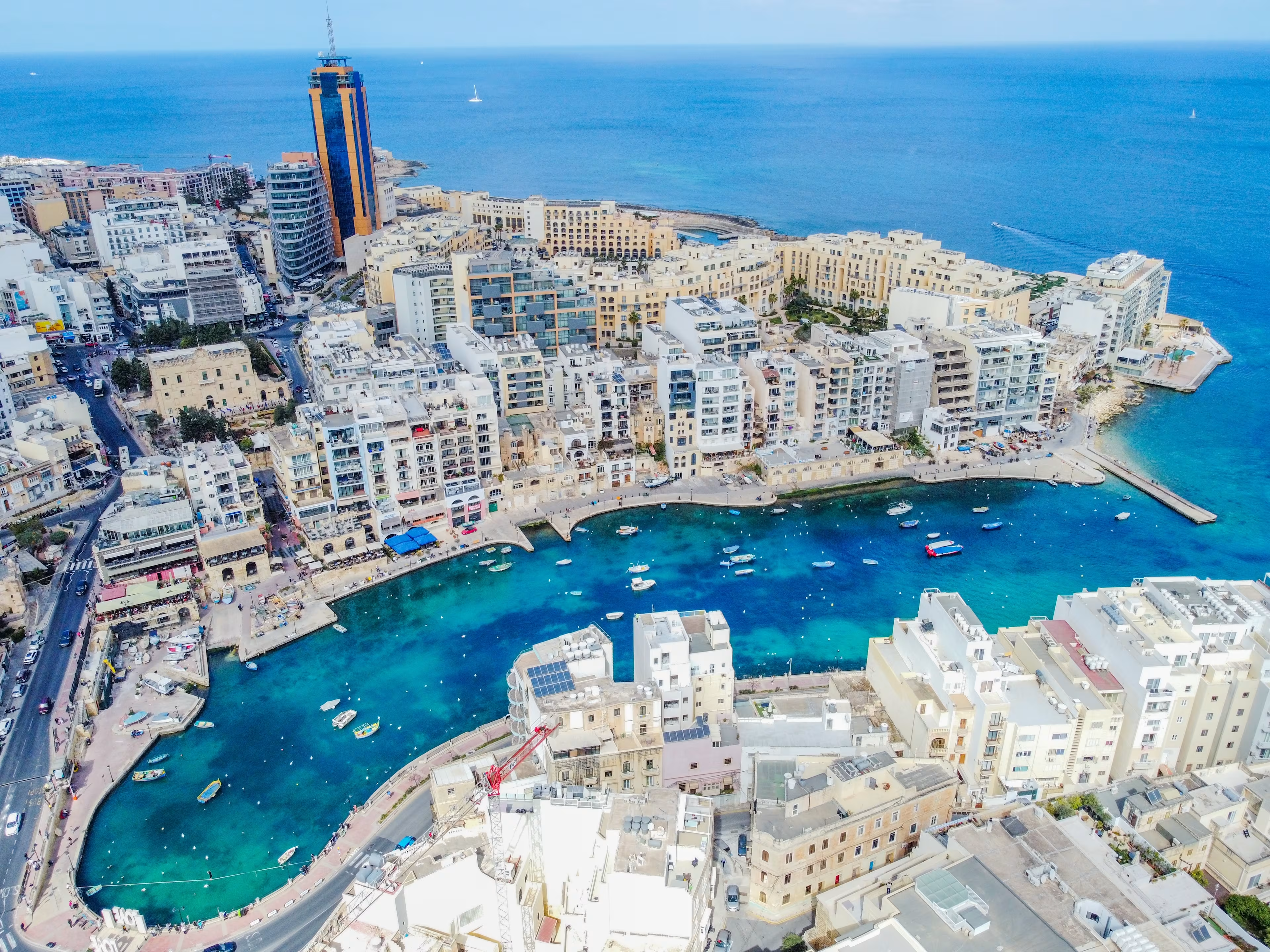
Malta 2026: Europe’s Most Accessible and Vision-Driven Market for Global Investors and HNW Relocation
Malta is no longer simply a picturesque island with good weather. It is evolving into a high-value platform for capital, companies and families who prioritise stability, connectivity and long-term optionality within the European Union.
Malta 2026: Europe’s Most Accessible and Vision-Driven Market for Global Investors and HNW Relocation
Malta is entering 2026 with a level of stability and strategic clarity that distinguishes it within the European Union. While many jurisdictions are reassessing their approach to investment, residence and market openness, Malta is strengthening its position as a reliable base for global investors and internationally mobile families. With a resilient property market, a long-term national vision and a welcoming lifestyle, the country is shaping a compelling proposition for those seeking security, opportunity and continuity in the EU.
Malta is no longer simply a picturesque island with good weather. It is evolving into a high-value platform for capital, companies and families who prioritise stability, connectivity and long-term optionality within the European Union.
Malta’s Vision 2050: From Small Island To High Value Platform
The government’s Malta Vision 2050 sets out a long term direction that matters to serious investors. Rather than focusing narrowly on GDP, the strategy tracks progress using indicators such as education outcomes, median disposable income and well being. It is built around four pillars: sustainable economic growth, citizen centred services, resilience supported by modern education, and smarter land and sea use.
For investors, the important signal is sectoral. The government is explicitly prioritising high value industries such as financial services, digital innovation and gaming, maritime and logistics, life sciences, aviation and niche advanced manufacturing.
This policy direction is backed by performance. KPMG’s Malta Economic Outlook notes that real GDP expanded by 4.9% year on year in the third quarter of 2024, following several quarters of strong growth. European Commission projections still place Malta among the faster growing economies in the euro area in 2025 and 2026. Malta’s economy continues to outperform wider Europe, with real GDP growth projected at approximately 4% for 2025—significantly higher than the EU’s average forecast of around 1.4%. This growth differential reinforces Malta’s position as one of the most resilient and opportunity-rich markets in the EU.
For HNWIs and family offices, this combination of clear long term vision and above average growth inside the EU is already a differentiator.
Property, Cost of Living and Capital Preservation
For globally mobile families, relocation decisions are ultimately about balance sheets as well as lifestyle. Malta’s property market and cost-of-living profile are central to that calculation.
A property sector that anchors the real economy
Recent work by KPMG for the Malta Development Association estimates that the wider building industry contributed about €2.7 billion to gross value added in 2023, roughly 14.1% of national GVA. At a recent luxury property exhibition in Shanghai, Malta’s Minister for Justice and the Reform of the Construction Sector, Jonathan Attard, cited KPMG findings and emphasised that once indirect effects are included, property and construction account for nearly 14% of GVA and employ thousands of people.
This is not a marginal segment of the economy. It is a core pillar that drives employment, innovation around sustainability and urban regeneration, and in turn supports sectors such as tourism, professional services and retail.
KPMG’s real estate data also shows that Malta’s housing market has delivered sustained appreciation with manageable volatility. Between 2015 and 2023, property prices in Malta increased by 53.4%, compared with 48.1% for the EU as a whole, equivalent to a compound annual growth rate of about 5.5% versus the EU average of 5.0%.
A separate study based on KPMG’s database and reported by local media found that the average asking price of apartments rose by around 10% in a single year, reaching about €414,600 in 2025. For investors who bought earlier, this has already translated into meaningful capital gains. For new entrants, it signals a market that is still growing but supported by real demand.
Space, affordability and the housing-cost burden
One of the most interesting KPMG findings for incoming families is not just price growth but affordability and space.
According to the Malta Economic Outlook, Maltese households spend around 12.0% of their disposable income on housing costs, compared with an EU average of 19.7%. This lower housing-cost burden gives residents more room for savings, education and discretionary spending, which is highly relevant for families planning for multi-generational wealth.
Malta also offers unusually generous living space in an EU context. In 2023 the country recorded the largest average housing size in the EU, with 2.2 rooms per person compared with an EU average of 1.69, and one of the lowest overcrowding rates at just 2.4% of the population.
For HNW families accustomed to cramped city apartments in other capitals, being able to secure a sizeable waterfront or historic property, with international schools and healthcare close by, is a non-trivial advantage.
Cost of living: European standards, Mediterranean premium
Independent cost-of-living assessments broadly position Malta as mid-range for Europe, but significantly more competitive than major Anglo-Saxon hubs. Expatriate estimates suggest that a single person can live comfortably in Malta on €1,800 to €2,000 per month including rent, while couples typically budget €2,500 to €3,000 depending on lifestyle and location.
One long-term expatriate couple told an international living survey that their two bedroom seafront apartment in Sliema would cost roughly three times as much in New York City, while everyday costs like restaurants remain lower.
For HNWIs, this is not about penny counting. It is about value. Malta allows capital to be deployed into quality property, education and experiences, rather than being absorbed entirely by housing and tax.
Migration, Residency and Geopolitics: Malta In A Tightening Europe
The global mobility landscape has changed markedly in the last few years. Several EU states have either shut down or significantly scaled back their classic “golden visa” programmes, particularly those linked to real estate.
Portugal and Ireland have closed their property based residence by investment routes, while tightening broader immigration rules. Spain formally ended its golden visa programme in 2025, explicitly citing concerns about housing affordability. Greece and other countries have increased minimum investment thresholds and enhanced scrutiny. At the same time, several EU members are discussing or implementing rules that lengthen residence periods required for citizenship and introduce tougher tests for integration and dual nationality.
Cyprus is another country in the region where things are changing. The government says it wants to join the Schengen Area by 2026, but recent reports show it may not be fully ready, with several technical and political issues still needing attention, including how border controls would be managed. For investors who care about long-term travel rights and smooth EU access, this uncertainty makes Malta look more reliable and straightforward in comparison.
Malta has not been immune to this shift. Its citizenship-by-investment scheme has been challenged at EU level, and the country has responded by moving away from the “passport for sale” model and towards more conventional residence frameworks that emphasise physical presence, due diligence and value creation.
The key point for investors is that Malta still offers predictable, rules based routes to long term residence, at a time when competitors are narrowing theirs. Options include the Malta Permanent Residence Programme and a Nomad Residence Permit for remote workers, alongside more traditional residence schemes for economically self sufficient individuals. These programmes sit within the broader Vision 2050 context and are calibrated to align with EU standards rather than exploit gaps in them.
In other words, while many EU jurisdictions are tightening access for investors, Malta is repositioning, not retreating. It aims to be selective, compliant and long term, rather than opportunistic.
Sentiment, Confidence and the Local Mood
A country’s atmosphere matters deeply to internationally mobile families, and Malta offers one of the warmest, most welcoming environments in Europe. The local mood remains reassuringly positive, supported by a sense of stability and steady progress that investors naturally look for.
Recent survey work reported by MaltaToday shows that nearly one third of people in Malta expect 2026 to be better than 2025, and a majority say their household income held steady or improved in the previous year.
The government is also actively taking Malta’s story overseas. At the LPS Shanghai Luxury Property Exhibition, Minister Jonathan Attard told investors that “Malta is open for business” and described platforms like Property Malta as central to promoting the country and strengthening trust and integrity in the sector.
For globally mobile capital, this combination of domestic confidence and outward engagement is a positive signal.
Why Malta 2026 Deserves A Serious Look From HNWIs
Taken together, Malta’s advantages form a distinctly coherent proposition for high-net-worth individuals and global investors assessing their options for 2026.
The economy continues to outperform the EU average, supported by a long-term national strategy that prioritises innovation, talent and sustainable growth. This macro stability feeds into a property market that contributes meaningfully to national GVA, has shown consistent price appreciation and still offers generous space by European standards with a comparatively lower housing-cost burden.
Living costs remain competitive for an EU jurisdiction, particularly when benchmarked against major financial centres such as London or New York. This allows families and investors to allocate more resources to education, philanthropy and entrepreneurial initiatives.
Importantly, Malta remains one of the few EU jurisdictions that continues to offer clear, structured and predictable pathways for investors and internationally mobile families, at a time when many member states have tightened or withdrawn similar routes.
Proactive government engagement, combined with the analytical depth offered by institutions such as KPMG and promotional bodies like the Property Malta Foundation, helps shape an ecosystem that is transparent, data-driven and aligned with investor needs.
For global investors, the decision is rarely about finding a perfect jurisdiction. It is about identifying a location where economic strength, lifestyle quality, regulatory clarity and openness to international wealth align. In 2026, Malta offers a combination of these factors that compares favourably with many alternatives.
For HNW families seeking a stable EU base, a resilient property market and a comfortable environment for future generations, Malta is increasingly emerging as a compelling choice.